TL;DR: The era of using 70B autoregressive LLMs for simple agent routing is coming to an end. Convai Innovations' open-source Laya (a 421M ModernBERT-large decision model) challenges TypeSafe's hosted Jev primitive. Benchmark charts show Laya delivering a 7.8x speed advantage (32.8 ms vs 236–276 ms), 3x tighter probability calibration (ECE 0.081 vs 0.246), and 45/51 usable languages at zero self-hosted software cost. However, in mission-critical agent pipelines, raw benchmark accuracy is only half the battle: the real determinant of production reliability is confidence thresholding and fail-closed handoffs when faced with ambiguity.
1. The "Breakthrough" Debate & The Rise of System 1 Decision Engines
In early September 2026, when TypeSafe launched its proprietary Jev engine (e.g. jev-1.13.0), it framed non-autoregressive decision primitives as a breakthrough paradigm for AI workflows. Rather than generating variable-length text via token autoregression, Jev offered deterministic choice and confidence scores.
Shortly thereafter, Nandha Kishor M (founder of Convai Innovations) published a viral technical retrospective on DEV Community: _"I Built Non-Autoregressive Decision Models a Year Ago. Then a Frontier Lab Called It a 'Breakthrough'"_. Alongside the post, Convai released Laya—an Apache-2.0 decision engine powered by ModernBERT-large weights on Hugging Face (convaiinnovations/laya).
This dispute highlights a massive architectural inflection point in agent engineering: the separation of System 1 (fast, intuitive, non-generative classification) from System 2 (slow, reflective, autoregressive reasoning).
┌────────────────────────────────────────────────────────┐
│               Incoming User Request                    │
└───────────────────────────┬────────────────────────────┘
                            │
              [System 1: Fast Decision Engine]
              (Laya: ~33ms / Jev: Hosted API)
                            │
               Is Confidence >= Threshold?
                   /                 \
                 YES                  NO
                 /                     \
       [Auto-Adopt Route]       [Fail-Closed Handoff]
    (Target Specialist Tool)    (Human Review / Fallback)
Using GPT-4 or Claude 3.5 Sonnet to pick between five sub-agents or tools costs hundreds of milliseconds (often 800ms–2.5s), consumes significant tokens, and risks JSON syntax truncation or schema hallucination. Decision engines solve this by eliminating text decoding entirely: they take an arbitrary state (plain text, tickets, or JSON) and return categorical log-probabilities in a single forward pass.
2. Head-to-Head Benchmark Findings
Convai Innovations published an extensive multi-axis comparison contrasting Laya against third-party published figures for TypeSafe Jev (benchmarked by AbdelStark and nlbzard).
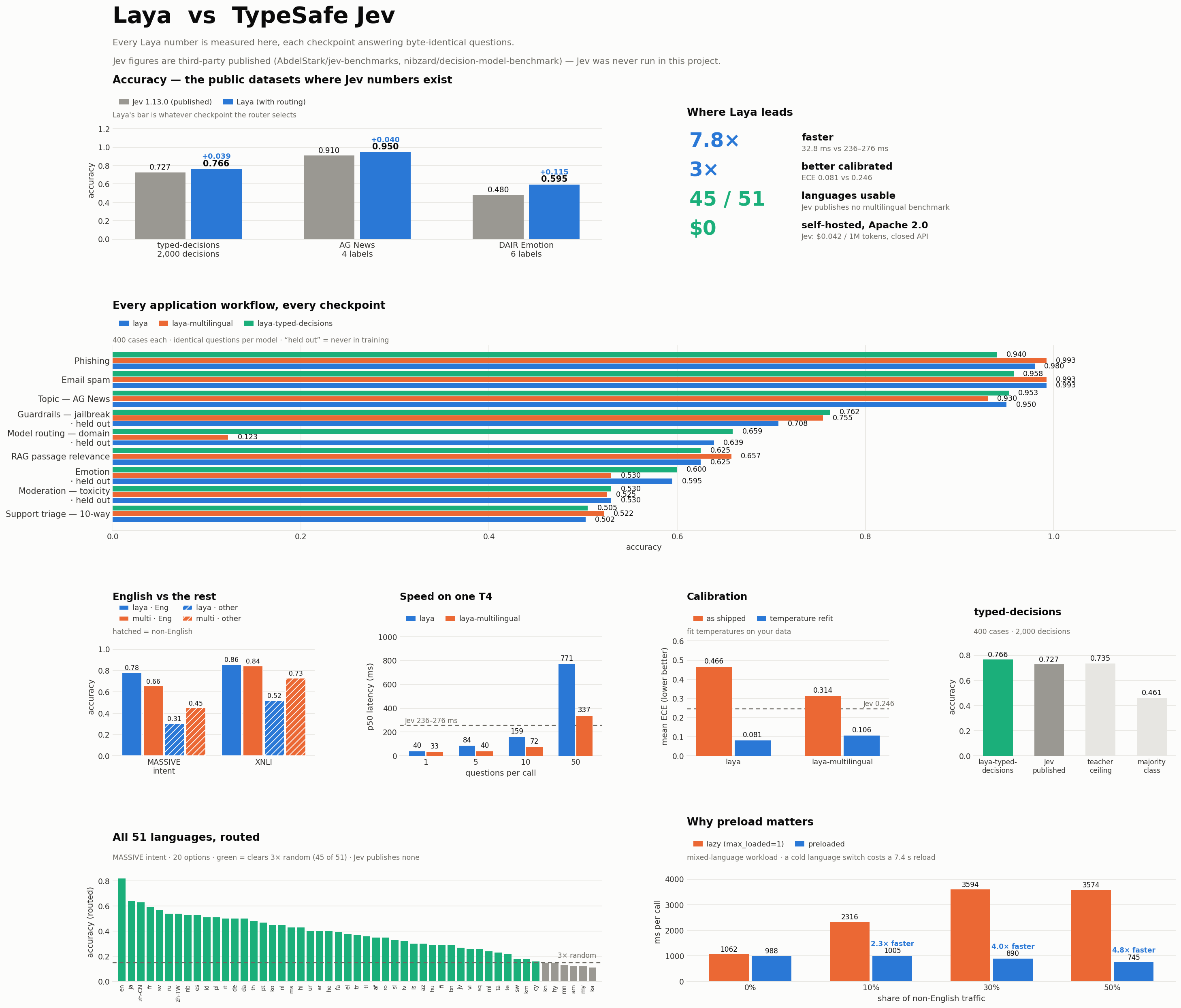
Here is how the numbers break down:
| Metric / Dimension | TypeSafe Jev (1.13.0 Published) | Laya (Convai Innovations) | Advantage / Delta |
|---|---|---|---|
| P50 Latency (1 question) | 236 – 276 ms (hosted API) | 32.8 ms (local T4 GPU) | 7.8x faster |
| Batched Throughput (50 q) | N/A (concurrency capped) | 7.2 ms / question (337 ms total) | Massive local scale |
| Calibration (Mean ECE) | 0.246 (moderate drift) | 0.081 (with temperature refit) | 3x tighter calibration |
| License & Pricing | Closed API ($0.042 / 1M tokens) | Apache 2.0 ($0 self-hosted) | 100% Free & Open |
| Multilingual Reach | Unspecified / English-focused | 45 / 51 languages usable | Broad global coverage |
| Privacy Boundary | Egresses to public endpoint | Air-gapped / Local process | Zero egress risk |
Accuracy on Public Benchmarks
On public datasets where published Jev evaluations exist, Laya reports consistent margins:
typed-decisions(2,000 evaluations): Laya achieves 0.766 vs Jev's 0.727 (+3.9%). Notably, Laya exceeds the estimated teacher ceiling (0.735).AG News(4 labels): Laya posts 0.950 vs Jev's 0.910 (+4.0%).DAIR Emotion(6 labels): Laya scores 0.595 vs Jev's 0.480 (+11.5%).
Robustness Across Production Workflows
In held-out tests (never seen during training), Laya's three checkpoint variants (laya, laya-multilingual, laya-typed-decisions) maintain high predictive discipline:
- Phishing Detection: 0.940 – 0.993
- Email Spam Classification: 0.958 – 0.993
- Topic Categorization: 0.930 – 0.953
- Guardrails (Jailbreak Detection): 0.708 – 0.762
- RAG Passage Relevance: 0.625 – 0.657
- 10-Way Support Triage: 0.502 – 0.522
3. Architecture Deep-Dive: ModernBERT vs Proprietary Black Box
Why is Laya capable of responding in 32.8 ms while remaining competitive with closed frontier models?
1. The ModernBERT-Large Backbone (421M Parameters)
Laya is built on the ModernBERT architecture—a modernized bidirectional encoder transformer featuring FlashAttention-2, rotary positional embeddings (RoPE), unpadding, and an expanded 8k context window. Unlike decoder-only causal models that generate tokens sequentially ($O(N)$ autoregressive steps), an encoder evaluates all input tokens concurrently in a single matrix multiplication pass.
2. RLCD Training (Reinforcement Learning with Calibrated Decoding)
Standard classification models often suffer from overconfidence when scaled. Laya employs RLCD—optimizing the network against strictly proper scoring rules (such as Brier score and log-loss). The output layer is trained not just to maximize the top-1 argmax, but to output mathematically honest probability distributions.
3. Checkpoint Specialization & The Preload Effect
Laya ships three fine-tuned checkpoints orchestrated by a lightweight Python Router:
from laya import Router

# Preload weights into GPU memory to eliminate dynamic initialization penalties
router = Router(preload=True)

decision = router.route({
    "task": "Review pull request #104 for potential race conditions",
    "context": "diff --git a/worker.go b/worker.go..."
})
Convai's benchmarks reveal that in mixed-language workloads, dynamically reloading weights incurs a 7.4-second cold-load penalty. Preloading all three weights keeps per-call latency flat across arbitrary language distributions: 4.8x faster at 50% non-English traffic (745 ms vs 3,574 ms).
4. The Calibration Reality: ECE and Fail-Closed Routing
In agent architecture, confidence calibration is far more important than raw classification accuracy.
Consider what happens when an agent routes an incoming customer query:
- If the model predicts
code_searchwith confidence $0.98$, the system should automatically dispatch the action without human friction. - If the model predicts
code_searchwith confidence $0.52$, the system must recognize that it is guessing and initiate a fail-closed handoff (escalating to human review or triggering an interactive clarifying question).
Expected Calibration Error (ECE): Lower is Better

Laya (Shipped):        [=================] 0.466
Jev (Published):       [========] 0.246
Laya-Multi (Refit):    [===] 0.106
Laya (Temp Refit):     [==] 0.081
Uncalibrated models exhibit confidence drift: they may assign a 95% confidence score to inputs they get wrong 40% of the time. Laya's raw checkpoints ship with an ECE of $0.466$, but when fitted with temperature scaling on target domain data, its ECE drops to 0.081—significantly lower than Jev's published $0.246$.
5. The JevLab Perspective: Measuring the In-Between
At JevLab, our core design philosophy is:
_Accuracy without thresholding is an illusion. In production, your policy lives or dies by your handoff boundary._
While Convai's published charts are compelling, an independent engineering team must note two crucial caveats:
1. Third-Party Data vs. Side-by-Side Controlled Runs: As Convai transparently discloses, Jev's figures were derived from third-party published numbers (AbdelStark/jev-benchmarks, nlbzard/decision-model-benchmark) rather than an active, byte-identical side-by-side run executed under identical network conditions. 2. The Ambiguity Penalty: In real-world agent environments, tasks are frequently messy:
- _"Find where the auth token is parsed and update the tests to mock it"_ (Multi-intent: both
code_searchandtest_runner). - _"What does this function do?"_ with no code attached (Information-deficient).
When faced with ambiguity, an unconstrained router will pick a label with artificially inflated confidence, executing the wrong tool and corrupting downstream state.
In JevLab's benchmark design, we explicitly partition datasets into:
- Reviewed Validation / Test Sets: Measuring auto-adopt accuracy ($A/N$) and error rates on unambiguous tasks.
- Adversarial Challenge Sets: Specifically evaluating whether the model's confidence collapses on ambiguous prompts, allowing a preset threshold (e.g. $t = 0.80$) to cleanly trigger a handoff.
6. The Production Decision Matrix
Should your team adopt Laya or integrate TypeSafe Jev?
                                  Decision Flowchart
                                          │
                         Need zero data egress / HIPAA / air-gap?
                                   /              \
                                 YES               NO
                                 /                  \
                        [ Choose LAYA ]      Have GPU infra (T4/A10G)?
                       (Apache 2.0 Local)            /         \
                                                   YES          NO
                                                   /             \
                                        Need <50ms P50?    [ Choose JEV ]
                                            /      \       (Serverless API)
                                          YES       NO
                                          /          \
                                  [ Choose LAYA ]  [ Evaluate JEV vs LAYA ]
Choose Laya If:
- Ultra-low latency is required (<50 ms): You are building real-time voice agents, sub-second IDE completions, or high-throughput API gateways.
- Data privacy is non-negotiable: Source code, medical records, or customer emails cannot egress your VPC.
- You have existing GPU/inference infrastructure: Running a 421M parameter model on a single inexpensive T4 or L4 GPU yields millions of free monthly decisions.
- Multilingual inputs are common: You need out-of-the-box support across 40+ non-English languages.
Choose TypeSafe Jev If:
- You want a zero-maintenance, serverless architecture: You do not want to manage Python microservices, CUDA drivers, Triton inference servers, or GPU auto-scaling.
- Your stack is pure TypeScript / Edge: You prefer a lightweight SDK integration without hosting backend model artifacts.
- Usage is sporadic or experimental: At $0.042 per million tokens, low-volume workloads are cheaper than provisioning dedicated GPU cloud instances.
7. What's Next for JevLab
The arrival of production-grade open-source decision models like Laya validates what we have argued since day one: System 1 routing is foundational to robust agent architecture.
We are currently evaluating the addition of a Laya benchmark baseline to JevLab's public lab. Developers will soon be able to:
1. Compare Jev and Laya side-by-side across identical, human-verified agent task datasets. 2. Adjust confidence thresholds interactively to observe how auto-adoption vs handoff trade-offs differ between ModernBERT encoders and hosted decision APIs. 3. Export type-safe router code configured with empirical, battle-tested threshold boundaries.
Until then, you can explore our live benchmark report and test threshold policies on the JevLab Interactive Lab.
_Disclaimer: JevLab is an independent evaluation benchmark project and is not affiliated with TypeSafe or Convai Innovations. All trademarks and benchmark names belong to their respective owners._